Seeing Sharp: Prescription Sunglasses That Don’t Look Like an Afterthought

British sunlight has a habit of arriving sideways: low in winter, fierce off wet tarmac, briefly blinding on a coastal path. If you need vision correction, prescription sunglasses are not a niche extra — they are the pair you actually reach for from March to October, and often in November too. The good news is that 2026 has more frame shapes, lens materials and tint options than ever. The less good news is that a good-looking frame can still be a bad match for your prescription. So here is how to get both.
Start with the frame, then worry about the lens
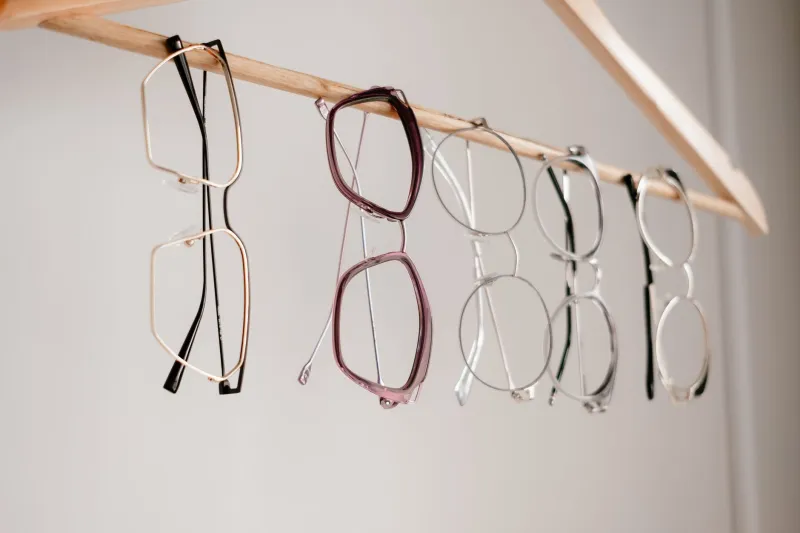
When you need vision correction, the frame has a job beyond looking good. It has to hold a lens that may be thicker at the edges (short-sighted) or in the middle (long-sighted). Very thin metal frames and rimless styles can look elegant, but they leave lens thickness on show. A slightly chunkier acetate frame, a rounded square, a soft rectangle, or an aviator with a substantial rim gives the lens somewhere to hide.
If your prescription is strong, smaller lens shapes are your friend. A 50mm-wide lens in a thick frame will usually look neater than a 58mm oversized shape. For higher plus prescriptions, a rounder frame with a moderate eyesize can balance the bulge. And don’t ignore the bridge: a well-fitting bridge keeps the glasses from sliding down your nose, which is especially annoying when you are driving or walking. If you are trying frames on the High Street, check the temple length too. A frame that pinches behind the ears will never feel like a proper pair of sunglasses, no matter how good the lens is.
Tints and polarisation for the great British forecast
The UK is not a sun-drenched country, but glare is everywhere: wet roads, grey skies, car bonnets, the sea at Brighton, the side of a bus. For everyday wear, a Category 2 or Category 3 lens covers most conditions. Category 4 is for serious alpine or water sports and should not be worn for driving.
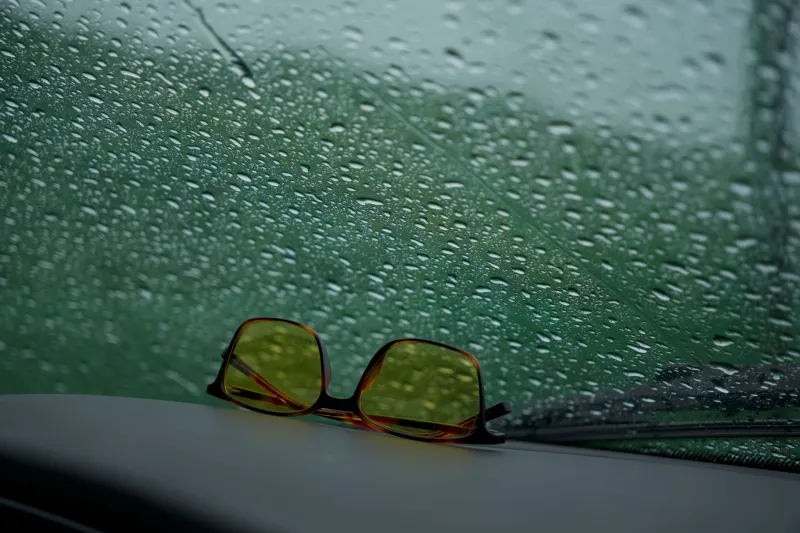
Grey lenses are the neutral all-rounder: they reduce brightness without shifting colours, which is why they suit city days and coastal walks. Brown or amber lenses add warmth and contrast, handy on flat, grey afternoons. Green lenses, especially the classic G15 style, are easy on the eyes over long periods and remain a safe choice for all-day wear. Rose or copper tints can lift contrast in low light, but they are less useful if you need accurate colour.
Polarisation is the big one for many UK wearers. It cuts glare bouncing off wet tarmac, water and glass, making it a sensible choice for drivers and anyone who spends time near the coast. It can make some LCD screens look odd at certain angles, but for most daily use it is a plus. Photochromic lenses are also worth considering if you commute in mixed light; just remember that car windscreens filter much of the UV that triggers the darkening, so they may not go as dark as you expect behind the wheel.
The prescription details that keep things sharp
A fashionable frame is no good if the lenses give you headaches. Ask for your pupillary distance (PD) when you have an eye test; it is the measurement between your pupils and it is essential for centring the lenses. High prescriptions may benefit from a higher lens index (1.6, 1.67 or 1.74) to keep thickness down, and aspheric lenses can help flatten the curve.
If you fancy a wrapped or sports-style frame, check that the manufacturer offers a prescription option or a prescription insert. Standard lenses in a very curved frame can distort vision. Also ask about coatings: an anti-reflective coating on the back surface reduces glare from behind, and a scratch-resistant coating is worth having on sunglasses that will live in a bag.
Optician fit, online price
There is no rule that says you must buy your prescription sunglasses where you had your eye test. Many people try frames on the High Street, note the model and size, then compare prices online. That can work well, but only if you are careful. Use the optician to get your prescription and PD, and try on frames to check bridge width and temple length. Online, check the returns policy, lens warranty and whether the retailer will verify your prescription. Virtual try-on tools are better than they were, but they will not tell you if a frame pinches behind the ears.
For varifocals, strong prescriptions or anything unusual, an in-person fitting is usually worth the extra. A good optician can adjust the frame, check the optical centre and make sure the sunglasses sit correctly. If you do buy online, don’t guess your PD, and don’t choose a frame that is much wider or narrower than the ones you have tried. It also pays to check for UKCA or CE marking on the sunglasses, and to confirm that the retailer is happy to work with your prescription rather than treating it as an afterthought.
A short checklist before you commit
- Frame: thicker rim or smaller eyesize for strong prescriptions; check bridge and temple fit.
- Lens: Category 2 or 3 for UK days; polarised if glare is a problem; photochromic for mixed light.
- Prescription: up-to-date test, PD measurement, correct lens index.
- Retailer: returns policy, prescription verification, UKCA or CE marking on the sunglasses.
- Style: pick a colour you will actually wear, not just one that looks good in the product photo.
Prescription sunglasses used to be the sensible option, not the stylish one. That has changed. With the right frame and lens combination, they can be the pair you reach for first — sharp on the school run, sharp on the coast path, and sharp enough for a pub garden in November. In 2026, there is no need to compromise.