The Three-Pair Rule: A Sunglasses Capsule Built for British Weather

British light is a bit of a diva. One minute you're squinting through a flat white glare on the walk to the station, the next it's blazing off a wet pavement hard enough to make your eyes water. Buying sunglasses here isn't really about chasing sunshine — it's about managing contrast. Which is why the capsule approach works so well, and why most of us are doing it wrong.
A capsule wardrobe, in the proper sense, isn't about owning fewer things for the sake of it. It's about owning things that overlap intelligently, so almost any combination works. Applied to sunglasses, that means three pairs with genuinely different jobs. Not three variations on black Wayfarers.
Why three is the magic number
Two is not enough, because you'll end up forcing one pair to do everything and compromising on the days that matter. Four is overkill for most people — you start buying for a hypothetical holiday that never quite happens.
Three splits neatly into: the everyday workhorse, the overcast-day specialist, and the one that makes an outfit. That's a base layer, a mid layer and a statement piece, essentially. Same logic as a good coat rail.
Frame one: the everyday neutral
This is the pair you'll reach for four days out of five. Buy it first, buy it well, and resist the urge to make it interesting.
Shape: keep it mid-sized and fairly classic — a soft rectangle, a gentle square, a rounded P3, or a slim oval. Nothing too small (it will look lost on anyone over 30) and nothing cartoonishly oversized. Fit beats fashion here; the frame should sit on the bridge without sliding and the temples should clear your ears without pinching.
Colour: tortoiseshell, warm brown, matte black, crystal grey or a muted olive. These all read as neutral against British wardrobes, which lean denim, navy, charcoal, oatmeal and the eternal black coat.
Lens: grey for true colour perception, brown for a bit more warmth and contrast. Aim for cat 2 or cat 3 — enough for a bright afternoon without turning a dull morning into a cave. Polarised is worth the extra tenner if you drive or spend time near water; it kills glare off wet roads and the sea rather than just dimming everything.
What it goes with: everything. Literally the point. Jeans and a tee, a blazer on a Thursday, a waxed jacket at the weekend, a wedding guest outfit if the shape is refined enough.
Frame two: the low-light specialist
This is the pair almost nobody owns and almost everybody needs. Britain deals in bright-overcast: light that's diffuse, flat and surprisingly tiring on the eyes, but not dark enough to justify a heavy tint.
Lens: this is where the money goes. Look for category 1 or light category 2, with a visible light transmission somewhere in the 40–80% range. Rose, amber and light yellow tints lift contrast beautifully on grey days — everything looks slightly warmer and sharper rather than merely dimmer. Gradients (darker at the top, lighter at the bottom) are great for commuting, because you can still read a phone or a platform sign through the lower half.
Photochromic lenses are the other strong option here: clear indoors and in the car in the morning, lightly tinted by the time you're walking home. Modern versions react faster than the ones your dad wore in 2004, and they're genuinely useful in a climate that changes its mind hourly.
Frame: lightweight metal or a thin acetate, ideally in a shape you'd be happy wearing indoors for a second. Something round or slim-rectangular. Keep it quiet — this pair is a tool, not a talking point.
What it goes with: autumn coats in olive, charcoal and rust. Knitwear. The kind of outfit you'd wear to a National Trust garden in October. It also quietly solves the problem of wearing sunglasses with a grey suit without looking like you've wandered off a photoshoot.
Frame three: the statement
Now have some fun. One pair, kept deliberately separate from the other two, that does a specific job: it makes a plain outfit look considered.
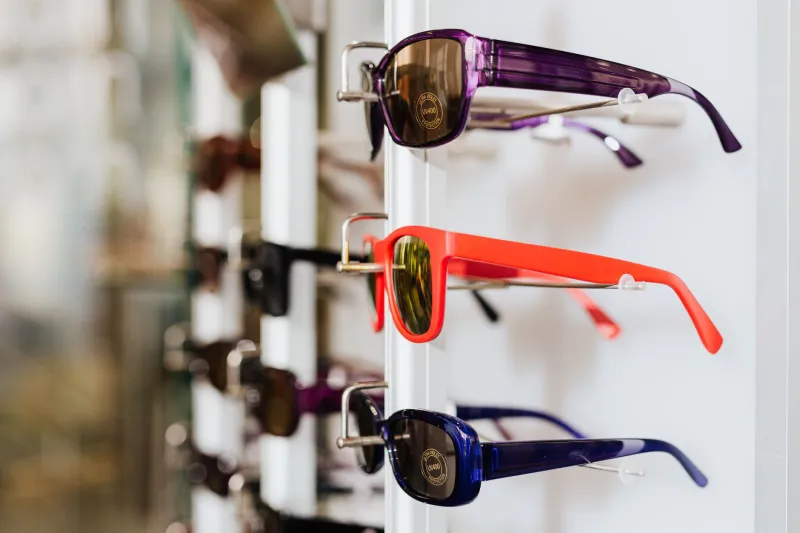
Go for the shape you've been circling for years — a strong cat-eye, a thick rectangular acetate, a small oval in a bright colour, a chunk of clear crystal, a slim metal aviator with a coloured mirror lens. Colour is your friend here: oxblood, bottle green, butter yellow, milky lilac, a deep cherry red. If the everyday pair is quiet, this one can be loud without tipping into costume.
The styling rule: let the frame be the only loud thing. Plain white tee, straight-leg jeans, canvas trainers. Or an all-black outfit in winter, where a bright frame does the job a necklace would. Statement sunglasses work badly with busy prints and work brilliantly with good, boring clothes.
The seasonal switch, roughly
- March to May: frame two gets hammered. Showers, bright breaks, low morning sun on the drive. Keep a microfibre cloth in your bag; spring rain plus road spray equals smeared lenses.
- June to August: frame one, polarised, cat 3. If you're heading to a festival or the coast, a cheap cat 4 pair for genuine glare is a sensible addition, but never wear cat 4 behind the wheel — they're far too dark for driving.
- September to October: back to frame two for the amber light and long shadows. Frame three gets an outing at anything with a drinks reception.
- November to February: the sun sits low and straight in your face at 3pm, which is arguably worse than midsummer. A cat 2 amber lens is far more useful in January than a heavy black one, and photochromics come into their own on the drive home.
Three mistakes worth avoiding
Buying the same silhouette three times is the classic one — you end up with a capsule that's really just one pair in different costumes. Check the shapes are genuinely distinct before you commit.
Second, prioritising brand over lens. A modest frame with a properly specified, UV400-rated lens will serve you better than a logo on a temple with a tint that does nothing.
Third, ignoring care. Acetate warps in a hot car, coated lenses hate a dry tissue, and hinges resent being yanked off one-handed. Buy a decent hard case, use both hands, and a three-pair capsule will last years rather than seasons.